
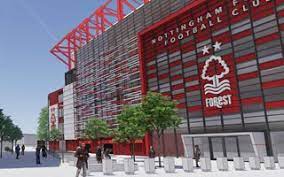
January 7 – Nottingham Forest have submitted plans that would almost double the City Ground’s capacity proposing an expansion from the current 30,445 seats to around 52,500 – a sharp shift in scale from earlier plans approved last summer.
Those original proposals, which focused on rebuilding the Peter Taylor Stand and adding 10,000 seats, now form just one part of a much wider vision backed by owner Evangelos Marinakis.
The timing feels bold considering the club’s tumultuous season, having already gone through three different head coaches and hovering startlingly close to the drop zone. But even in the midst of a difficult campaign, the City Ground has regularly seen attendances above the 99% capacity mark, as per Inside World Football’s capacity tracker.
Marinakis has pledged £130 million towards the project and described the expansion as a “significant investment” aimed at creating a “sustainable and iconic” stadium. The Forest owner has made clear he wants the City Ground to become the largest stadium in the East Midlands, complete with enhanced hospitality areas, a club museum and improved fan zones.
“This is about more than increasing capacity,” Marinakis said, saying the redevelopment is a project tied closely to the city’s long-term economic growth and identity.
The expanded plans are being prepared by KSS Design Group, a practice with a football pedigree through work at Liverpool’s Anfield and Leeds United’s Elland Road.
They are supported by a broader client team that includes Buro Happold, Gleeds and Savills. Forest have also brought in architect Konstantinos Chatzimanolis, formerly of Foster & Partners, who has been involved with the project since April last year.
The proposal encompasses the Peter Taylor Stand, Brian Clough Stand and the Trent End which are each set for ‘major redevelopment’, signalling a holistic rethink of the stadium rather than a single-stand solution.
The club insists supporters will remain Trentside throughout the construction process – a key point as discussions between the club, local authorities and residents continue. The club emphasised the regeneration aspect of the scheme, which would also includes changes to public spaces, pedestrian routes and landscaping around the stadium.
If delivered at the proposed scale, and without the need to relocate to different site, the redevelopment would not only transform Forest’s matchday experience, but reposition the City Ground as one of the Premier League’s most distinctive large venues.
Contact the writer of this story, Harry Ewing, at [email protected]