
September 10 – Paris tops a 2025 ranking of sports cities worldwide but hosting major football events and the upcoming 2026 World Cup is proving a driver of cities up the ranking of cities with the strongest association with sport.
Los Angeles ranks second in the list – it hosted Club World Cup games this year as well as Concacaf Gold Cup matches, will host games at the 2026 World Cup and in 2028 will host the Olympic Games. New York ranks third
Cities riding the wave of World Cup focus include Miami’s climb to eighth (from 16 in 2023) and Boston’s nine-place jump to 17th. Mexico City rose 12 spots to 18th.
All of the top 10 ranked cities are home to many of the world’s biggest football clubs.
The annual ranking by Burson, the global communications business that is part of the WPP Group, identifies the top 100 cities worldwide.
The ranking criteria is based on both perception and in-depth quantitative analysis, including feedback from international sports leaders, sports media representatives and industry experts, as well as social media and media coverage analytics, said Burson. The ranking also includes PR metrics derived from comprehensive media tracking.
Burson highlights five key trends that is says are reshaping the global sports landscape:
- Olympic hosting follows a predictable cycle: pre-Games momentum, peak visibility during the event, followed by post-Games decline. Strategic cities, however, can achieve recovery through legacy activation, as seen with Rio de Janeiro’s remarkable 41-position jump since 2023 (#74 to #33).
- Major international events are boosting North America’ sports cities’ profile – in particular the Club World Cup, 2026 world Cup and 2028 Olympics. The U.S., including the FIFA Club World Cup 2025, FIFA World Cup 2026 and 2028 Olympics.
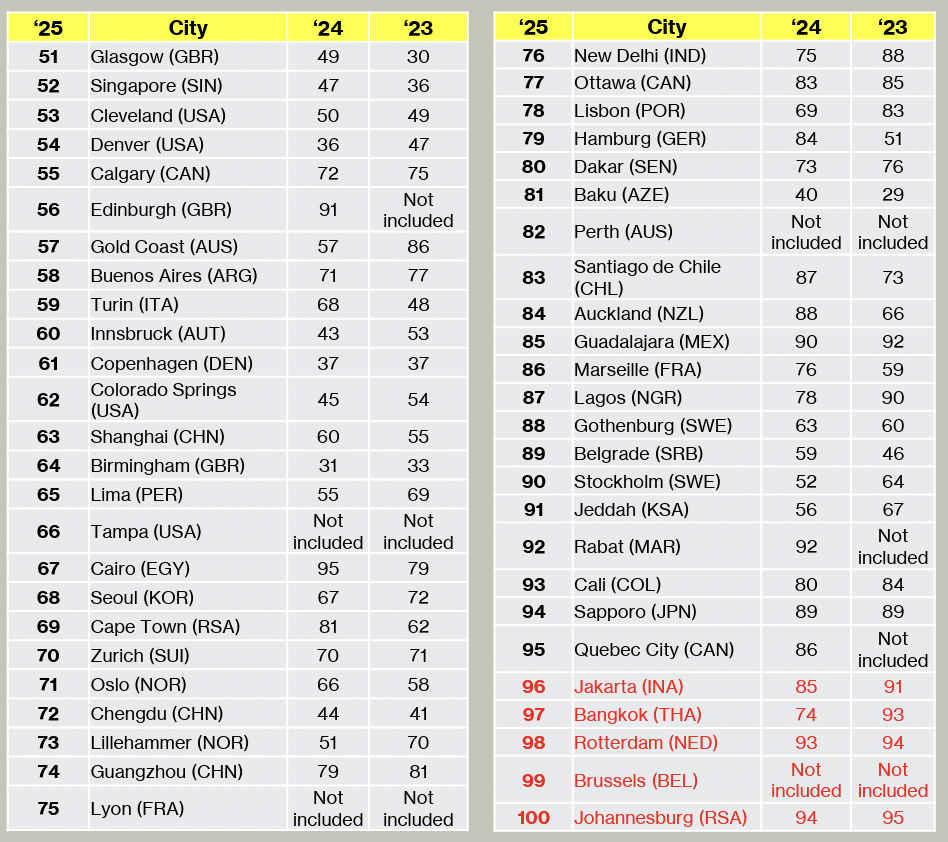
- Strategic investment in women’s sports directly correlates with a city’s accelerated rise in sports prominence and overall profile. Lyon’s entry at number75, largely due to its dominant women’s football team, is the leading example.
- Top-performing cities are moving beyond isolated events to embrace year-round sports ecosystems. Madrid (ranked 5) balances elite football clubs and major tennis events, while Miami (ranked 8) leverages a diverse mix including Lionel Messi’s presence, Formula 1 and tennis.
- Artificial intelligence (AI) is rapidly transforming the sports landscape, offering new competitive advantages. Cities benefit as their hosted events and leagues use AI to amplify reach and engagement. Real Madrid’s ‘Madrid Innovation District’ and partnership with Adobe, leveraging AI for fan engagement, bolsters the city’s ranking, while Munich (ranked 7) and Boston (ranked 17) also show gains from digital initiatives and advanced fan experiences.
“The 2025 Ranking of Sport Cities underscores the dynamic and evolving nature of the global sports landscape,” said Greg Curchod, CEO of Burson Switzerland.
“While mega-events remain crucial, this year’s findings highlight the increasing importance of strategic long-term planning, investment in diverse sports offerings, particularly women’s sports, and the innovative application of technology like AI to enhance a city’s sports reputation and engagement.”

Contact the writer of this story at [email protected]m