
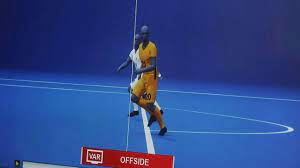
January 8 – FIFA is marching towards a fully technologised game and took another decisive step this week, with confirmation that every player at this summer’s World Cup will be represented by a physically accurate “AI avatar” to help make offside decisions.
President Gianni Infantino, during a keynote appearance at the Consumer Electronics Show in Las Vegas, said the system will see all players digitally scanned before the tournament. Those scans will be used to create personalised 3D models, designed to feed into semi-automated offside technology and, in FIFA’s view, remove even more doubt from Video Assistant Referee (VAR) decisions.
Infantino, never shy with the superlatives, insists the avatars would “ensure” more accurate offside calls.
“AI-enabled 3D avatars will ensure precise player identification and tracking,” he said, calling it “a big advancement in semi-automated offside technology, providing great images, faster decisions, and a clear understanding by everyone”.
Semi-automated offside technology already relies on dozens of cameras tracking the ball and up to “10,000” data points per player. The missing piece, according to FIFA, is that current models do not reflect a player’s true physical dimensions.
By introducing player-specific body dimensions, the game edges closer to a police crime scene with forensic judgment, now the barometer. Fans are already asking whether a 6ft 5in striker like Erling Haaland becomes more vulnerable to marginal calls than a 5ft 7in Lionel Messi, simply because there is more of him to be offside.
FIFA says each scan will take “approximately one second” and capture “highly accurate body-part dimensions”. Those models will then be used by VAR and integrated into broadcasts, allowing decisions to be “displayed more realistically and in a more engaging way to fans at stadiums and to viewers around the world”.
As with all technological advancements, there are pros and cons.
For the former, fewer delays, clearer visuals, and decisions that are easier to explain in a game, increasingly frustrated by opaque VAR calls, however, the more the game leans on machines, the further it drifts from its emotional core.
Football, for better or worse, has always lived in the grey areas. The fear is not that technology gets decisions wrong, but that it gets them right in a way that feels wrong.
Alongside the avatar rollout, FIFA also announced Football AI Pro, a new data platform developed with Lenovo that will be available to all World Cup nations and aims to “help level the playing field” between richer and poorer teams in an increasingly data-driven sport”. There is even a World Cup edition Motorola Razr phone.
Progress and AI feel unstoppable, but whether it improves the game or rips out its soul remains the real question.
Contact the writer of this story, Nick Webster, [email protected]