
April 9 – The Sports Integrity Global Alliance (SIGA) has released its report on gender representation in international sports governance, covering the 30 federations within the Association of Summer Olympic International Federations (ASOIF).
The key findings show that women have made huge strides in breaking the glass ceilings in sports that had prevented their progression to senior executive and administrative positions.
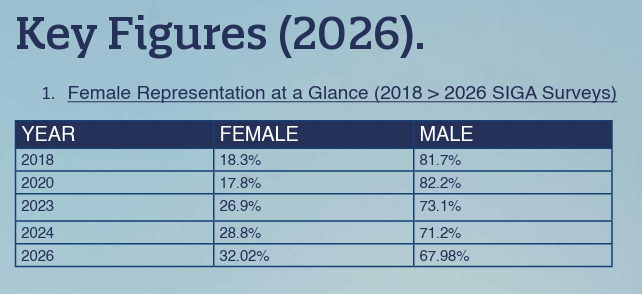
The report’s headline statistic is that women now hold 32.02% of executive positions, “reflecting sustained progress over the past decade”, says the report. This is an increase from 18.3% in 2018, but still doesn’t reflect true gender parity.
The numbers show 21 out of 30 federations have reached or exceeded the 30% benchmark with only World Athletics having achieved full gender parity (50/50) at executive level.
Comparing FIFA within the overall sporting governing body results, the FIFA Council has just eight female representatives out of 37 members.
In comparison to other world governing bodies, FIFA 26.6% of female representation at its top table is better than only six of the 30 international sports governing bodies surveyed.
Eight federations report female representation between 40% and 50%.
The report notes that despite this progress, the number of female Presidents of international governing bodies has decreased (from 4 to 3), and representation at the very top remains limited.
“Only 3 of 30 federations (10%) have female Presidents, and 5 (16.67%) have female CEOs or Secretaries-General, highlightingpersistent barriers at the highest decision-making levels,” notes the report.
“Progress is tangible but uneven, particularly in senior leadership roles. The data points to a positive trajectory, while underlining the need to consolidate and accelerate structural reforms to ensure lasting change.”
The survey concludes: “In March 2025, a historic milestone for gender equality in global sport governance was reached with the election of Kirsty Coventry as President of the International Olympic Committee. For the first time in the IOC’s history, a woman was elected tolead the Olympic Movement. This landmark moment demonstrates that long-standing barriers in sport governance can indeed be broken and sends a powerful signal about the importance of inclusive leadership at the highest levels of global sport…
“When leadership is inclusive, governance becomes stronger.”
Perhaps it is time for FIFA to look up the definition of ‘inclusive’?
To see the full report, click here: Survey
Contact the writer of this story at [email protected]