
January 28 – The United Soccer League (USL) has formally announced USL Premier as the name of its new Division One men’s league, unveiling a restructured men’s pathway that could have challenging implications for their competitors, Major League Soccer and the broader U.S. soccer landscape.
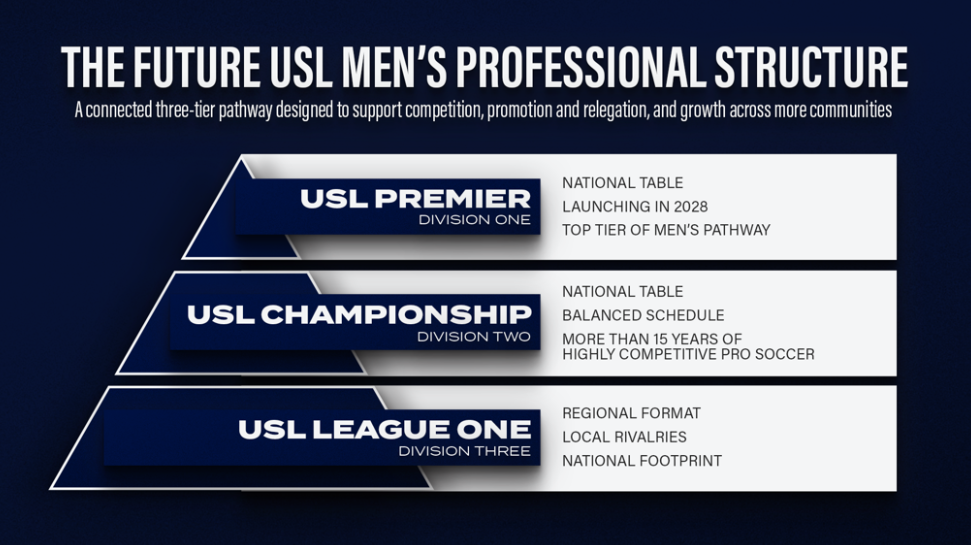
Set to launch in 2028, USL Premier will sit at the top of the pyramid of an interconnected three-tier professional system alongside the USL Championship and USL League One. The model is built around a unified national structure at the top two levels, regionalised competition in Division Three, and – most significantly, the most feared phrase in American professional sports – the introduction of promotion and relegation, a first for U.S. professional soccer.
“We’re trying to look out the next five to seven years, toward building a three-tiered integrated system linked together by promotion and relegation,” USL president Paul McDonough said. “We want to try to build towards this structure over the next five to seven years, and then we have enough runway to see how the country evolves, what the ecosystem is like, and we’ll evaluate as we go.”
Under the proposed framework, USL Premier will operate as a single-table national league with a long-term target of 20 clubs. The USL Championship will mirror that structure with its own 20-team national table, while USL League One will continue to expand nationally but compete regionally to support sustainability and local rivalries.
“USL Premier is a defining piece of our long-term vision for the men’s game,” said USL CEO Alec Papadakis. “We’ve built a multi-tier professional system that is both scalable and rooted in communities… unlocking meaningful opportunities for stakeholders and investors as we continue to grow the game and prepare to introduce promotion and relegation.”
The announcement inevitably invites comparison with MLS. While MLS remains the premier league and commercial force in U.S. soccer, its closed, single-entity structure stands in sharp contrast to USL’s open, performance-driven model. If USL Premier earns Division One sanctioning alongside MLS, the U.S. would feature two top-tier leagues built on fundamentally different economic and sporting philosophies.
That raises a central question – can the two leagues compete? For MLS, USL Premier introduces potential competition for players, investors, sponsors and fans, particularly in mid-sized markets that may value local identity and sporting jeopardy over franchise stability. For USL, the challenge will be converting structural ambition into sustained quality, visibility and commercial scale.
USL believes it is well-positioned to capture the growing demand for the world’s game, bolstered further by the arrival of Premier League chief football officer Tony Scholes, who will join USL Premier as president later this year.
Whether USL Premier ultimately complements MLS or competes directly with it may define the next era of American professional soccer.
Contact the writer of this story at [email protected]