David Owen: Is Spain v Holland a play-off for the 2018 World Cup?
.jpg)
So Spain versus the Netherlands it is.
And an obvious question presents itself for students of the race to host the 2018 World Cup: Is this an omen for the vote in December?

So Spain versus the Netherlands it is.
And an obvious question presents itself for students of the race to host the 2018 World Cup: Is this an omen for the vote in December?
.jpg)
Kite flying is not listed among the recreational interests of the former marathon running Sports Minister Richard Caborn. But this is precisely what dear old Dick appears to be doing in touting for the job of FA chairman.
“If people are up for change then I’m up for it and yes, I would stand,” says 66-year-old Caborn, who was among those deposed in the reshuffle of England’s World Cup 2018 bidding team.

Hamish Husband has been a travelling member of Scotland’s Tartan Army for more than 30 years, and in the last fortnight has offered a Scottish viewpoint on the 2010 World Cup finals and England’s efforts in several media outlets, including Channel 4 News and the News of the World.
Now this quintessential Scotland supporter answers a World Cup (and Wimbledon) quiz exclusively for insideworldfootball…
“On the other side of that roundabout, there will be goats by the side of the road.”
Few places better illustrate the vast wealth disparities that still exist in South Africa today than Alexandria.
.jpg)
Defeats are not easy to take, but they can be a springboard for success provided we are prepared to learn from them. The depressing thought is that England’s annihilation by Germany - and despite the disallowed goal, that is what it was – will not lead to the sort of revolution the national team needs.
So the debate in England has been whether Fabio Capello should stay or go. That is the wrong question.
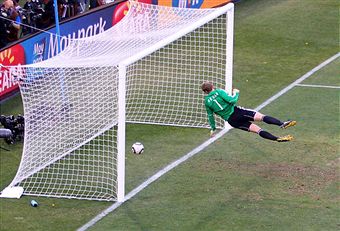
Sepp Blatter’s decision to re-open the file on goalline technology marks a stunning U-turn even by the standards of his undisputed mastery of football politics.
But before fans across the world get too carried away by the FIFA President bowing to global outrage following Frank Lampard’s “goal-that-wasn’t” for England, a little caution would be advisable.
England’s World Cup chances were doomed by their manager’s failure to understand or inspire his players, a state of affairs which meant that the team which took to the field had a subsconscious wish to punish him by failing to do their best.
And that ambivalence was strongest of all in the former captain, John Terry, whom Fabio Capello had stripped of his position and publicly rebuked during the group stages.
The line of questioning thrown at FIFA spokesman Nicolas Maingot the morning after the night before Frank Lampard’s already imfamous “goal-that-wasn’t” included the words laughing stock and embarrassment. You can understand why.
When football’s lawmakers ditched goal-line technology once and for all just over three months ago, FIFA general secretary Jerome Valcke said he hoped the decision did not come back to haunt the organisation at the World Cup.
By David Owen in Bloemfontein
June 27 – I need to make one thing clear at the outset: England were beaten today at Free State Stadium by a much better team: the 4-1 scoreline did not flatter Germany.
Hanover 1968 was where it all went wrong, as far as I was concerned.
To my mind, at that time, England were better than West Germany because they were the world champions. Which meant Charlton was better than Beckenbauer. Hurst was better than Seeler. Banks was better than Tilkowski. Moore was better than Schulz. It was all very simple.
On Wednesday night, as England qualified to meet Germany in the round of 16, with the USA topping England’s group and Australia doing Ghana a favour, the great and good of south African football returned to Sandton, the exclusive Johannesburg suburb which they have made their home during this World Cup, and their joy was unconfined.
The reason for the joy was not just on footballing grounds, although these are not insignificant.
They had a record six teams in the tournament but one by one they tumbled out, failing to live up to expectations, dashing the hopes of an entire continent.
The vuvezelas may still be screeching and organisers saying all the right things about the show going on but no-one can ignore the hugely disappointing performances of Africa’s teams at Africa’s World Cup.
Jabulani means “celebrate” in Zulu. But you would have to go a long way to find anyone, anywhere - player, coach or fan - remotely happy when it comes to the controversial ball being used in the World Cup.
After the vuvuzela, nothing has generated greater debate. Watch any game and watch freekicks flying over the bar, outfield players struggling with their control, passes being overhit and goalies fumbling.
If the BBC News channel had given Simon Meyerson just a little more time before England’s World Cup match against Algeria, he would have got round to the fundamental reason for the players’ collective under-performance, a reason that underlies their palpably stilted team ethic.
So when will USA withdraw its bid from the 2018 World Cup and concentrate on getting 2022 for the States?
On the day of the FIFA Congress, immediately after Australia withdrew from 2018, rumours swept Sandton, the once exclusive white suburb now dominated by the huge statute of Nelson Mandela where the good and great of football have gathered, that the USA was about to pull out.